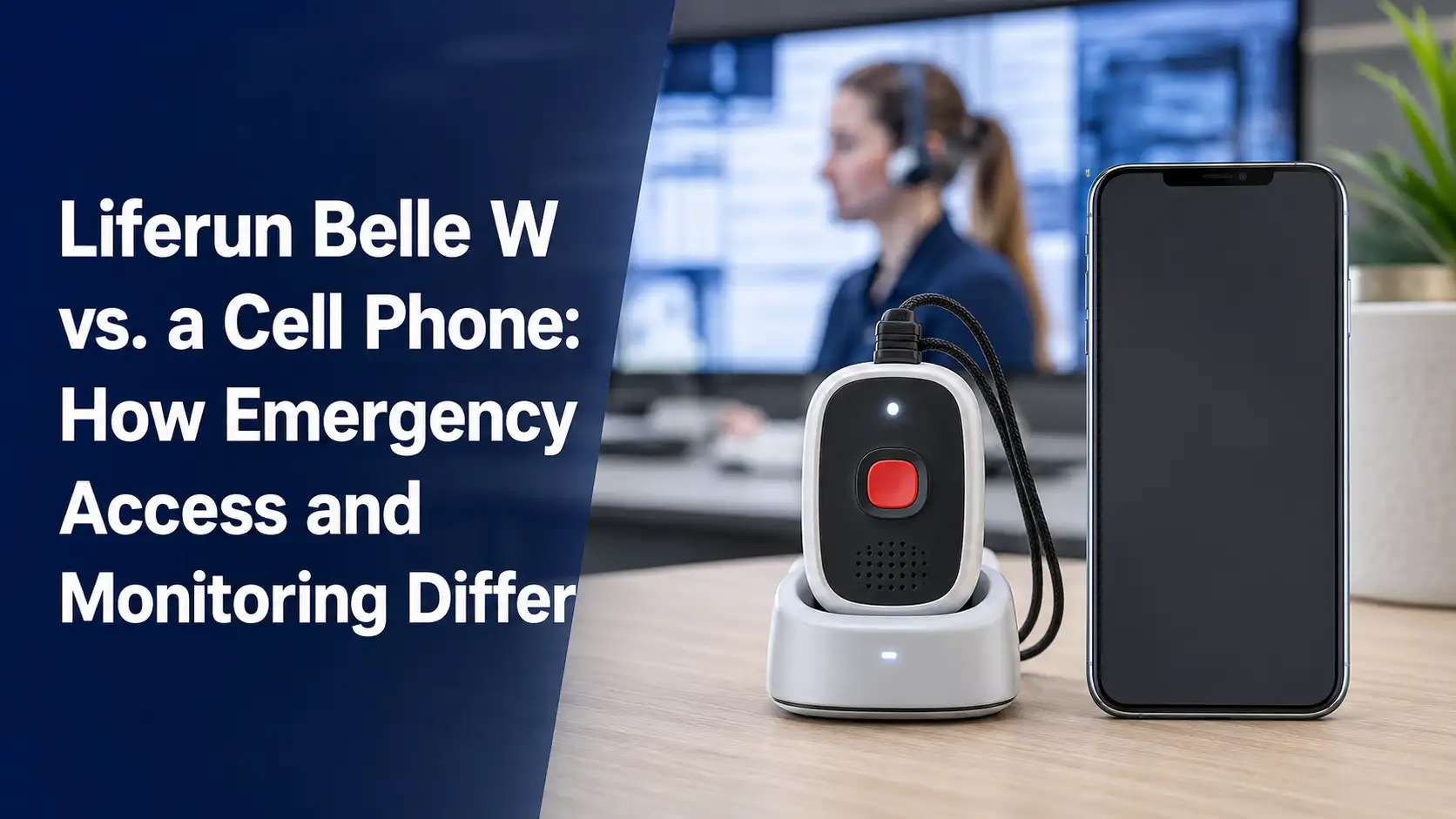
The main difference in LifeRun Belle W vs. a cell phone emergency access is what happens after you decide you need help. A cell phone can be used to call 911 directly when the phone is available, usable, and connected to a network. Belle W provides a dedicated wearable emergency button that connects through its built in two way audio to LifeRun’s 24/7 monitoring service where cellular coverage is available.
Neither approach should be described as universally better. They create different emergency pathways. Understanding those pathways is more useful than simply asking whether a medical alert device can “replace” a phone.
How Emergency Access Differs Between LifeRun Belle W and a Cell Phone
The key difference is not simply which device can reach help, but how the user initiates an emergency request and what happens after that request is made.
What Happens When You Need Help With a Cell Phone?
With a conventional mobile phone, the user normally has to locate the phone, unlock or activate it as necessary, open the calling interface or emergency function, and initiate a 911 call.
Wireless 911 calls are routed to a Public Safety Answering Point, or PSAP, that handles emergency calls for the relevant area. Wireless carriers also provide location information under FCC Enhanced 911 requirements, although mobile location determination has technical limitations and has continued to evolve.
Once connected, the caller communicates directly with the 911 system.
That can be an effective emergency path. A cell phone also has the advantage of being a multipurpose communication device that someone may already carry every day.
The limitation is that the user still needs to be able to access and operate the phone when help is needed.
What Happens When You Press the Belle W Button?
Belle W uses a more specialized emergency workflow.
Belle W is our mobile personal emergency response device with a dedicated one touch emergency call button, built in speaker and microphones, and direct communication with our trained monitoring specialists. Pressing and holding the call button activates communication with our monitoring center.
This means the wearer does not first have to:
- find a separate phone,
- open a dialer,
- search for an emergency contact,
- or navigate a normal smartphone interface.
The Belle W itself is the communication device.
Once an alert reaches our monitoring system, our operator can communicate with the wearer through the device and use the configured emergency protocol to determine what assistance is required. Our operators can communicate with contacts and dispatch necessary help.
That monitored intermediary is one of the biggest differences between Belle W and calling 911 directly.
Is LifeRun Monitoring the Same as Calling 911?
No.
This distinction should remain clear.
When you call 911 from a cell phone, you are attempting to connect directly to the public emergency communications system.
When you activate Belle W, you are connecting to LifeRun’s professional monitoring workflow. Depending on the situation and the user’s configured emergency protocol, a monitoring operator may contact family or other emergency contacts or request assistance from emergency services.
We do not describe LifeRun monitoring as “911 built into a watch.”
The two systems have different roles.
Cell phone path: User → 911 → Public Safety Answering Point
Belle W path: User → LifeRun monitoring → assessment and configured response → appropriate contact or emergency service when required
For someone comparing the two, that monitoring layer is a more meaningful distinction than the shape of the device.
Does Belle W Require a Cell Phone to Work?
No. Belle W does not require a landline or base station, and we build its two way communication directly into the wearable device. It operates through supported cellular networks rather than requiring the wearer to carry a smartphone alongside it.
Belle W is certified for use on AT&T and Verizon 4G LTE networks according to LifeRun’s current device information.
That independence can matter for someone who:
- does not regularly carry a smartphone,
- finds smartphone menus difficult to navigate,
- leaves a phone in another room,
- or wants an emergency function attached directly to the wrist.
It does not mean the Belle W can work without cellular infrastructure. Both a mobile phone and Belle W ultimately depend on compatible wireless network availability for their respective mobile communication paths.
Why Does Wearing the Emergency Button Matter?
A cell phone only helps when it is accessible.
A dedicated wearable medical alert device changes the location of the emergency control. Belle W is designed to be worn on the wrist, so the call button can remain physically attached to the user during normal daily activity. We designed Belle W as a lightweight wrist worn personal emergency response system.
That is a practical design difference rather than a guarantee of a better emergency outcome.
Someone may carry a cell phone constantly and find it perfectly accessible. Another person may frequently leave a phone charging in another room.
The relevant question is:
Where is the emergency communication device likely to be when the person actually needs it?
For some users, a wrist worn button can make the emergency access path simpler.
How Does Optional Fall Detection Change the Comparison?
A standard phone call generally requires the person to actively initiate communication.
We offer optional fall detection for Belle W. This feature can generate a fall alert even when the user does not manually press the emergency button.
That creates another difference between the two emergency pathways.
With manual access:
Wearer recognizes emergency → wearer initiates call
With enabled fall detection:
Device detects a qualifying fall event → alert can be sent to monitoring
Fall detection should not be interpreted as a guarantee that every fall will be detected. It is an additional alert mechanism rather than a replacement for the manual call button or a guarantee of emergency assistance.
How Is Location Handled Differently?
Modern cell phones and the wireless 911 system use network and handset location technologies to help emergency services determine where a wireless caller is located. The FCC has developed location accuracy requirements because identifying the position of a mobile caller can be more complex than locating a traditional fixed landline.
Belle W approaches location within a monitored medical alert system.
Our monitoring center can determine the device’s location to support emergency response, while Belle W includes location services as part of its capabilities.
Again, these are not identical systems.
A wireless 911 location process supports the public emergency communications network. Belle W location information supports the monitoring center’s handling of the medical alert event.
In either case, location technology should not be interpreted as a guarantee of perfect positioning in every environment.
What About Battery Life?
Battery management differs significantly between the two device categories.
Smartphone battery duration varies widely depending on the phone model, screen use, apps, cellular activity, navigation, and other functions.
Belle W has a much narrower purpose. We designed it to provide up to seven days of battery life per charge, with a full recharge taking approximately two to three hours.
The comparison is not simply “which battery lasts longer.”
The more useful question is whether the person can maintain the charging routine for the emergency device they depend on.
A completely depleted Belle W cannot maintain its monitoring connection, just as a dead cell phone cannot be used normally to place a wireless call.
Should You Keep a Cell Phone If You Use Belle W?
Belle W should not be treated as a reason to eliminate access to other communication methods.
The two devices serve different purposes.
A phone provides broad communication capabilities such as ordinary calls, messaging, internet access, navigation, contacts, and direct access to 911.
Belle W is focused on a much narrower task: providing a wearable emergency alert path to professional monitoring through a dedicated button and two way communication.
For many users, the practical comparison is therefore not:
Belle W or a phone?
It is:
What happens if an emergency occurs when using only the phone, and what additional access does a dedicated monitored wearable provide?
The answer depends on the person’s routine, ability to operate a phone during an emergency, cellular coverage, charging habits, and whether professional monitoring is desired.
The Difference Is the Emergency Workflow
When comparing LifeRun Belle W vs cell phone, both devices can provide a pathway to assistance, but the pathways are structured differently.
A cell phone gives you direct access to 911 when you can operate the phone and wireless service is available.
Belle W keeps a dedicated emergency button on the wearer and connects that alert to LifeRun’s 24/7 monitoring service, where an operator can communicate through the device and follow the user’s emergency response protocol.
That monitoring layer, combined with the wearable design and optional fall detection, is the central difference.
If you want to understand whether Belle W adds useful emergency access beyond the cell phone you already carry, contact LifeRun at 1-800-421-3366 to discuss your normal routine, emergency contacts, cellular coverage, and monitoring setup.
FAQs
Can Belle W call 911 directly?
Belle W connects first to our professional monitoring service. Our operators can then follow the configured emergency protocol and request the appropriate assistance when needed. We do not describe this as identical to dialing 911 directly from a cell phone.
Do you need a smartphone to use Belle W?
No. Belle W includes its own cellular connectivity, speaker, microphones, and emergency call button. No landline or home base station is required.
Can Belle W contact family instead of emergency services?
Our monitoring operators can communicate with the user’s contacts and dispatch necessary help according to the situation and emergency setup. We configure the exact response with each individual user.
Does Belle W work if there is no cellular signal?
Belle W requires compatible cellular coverage to connect with monitoring. Its certification on AT&T and Verizon 4G LTE networks does not guarantee service at every location.
Does Belle W replace a cell phone?
No. Belle W is a dedicated monitored emergency alert device, while a cell phone is a general communication device capable of directly calling 911 and performing many other functions. They solve overlapping but different communication needs.