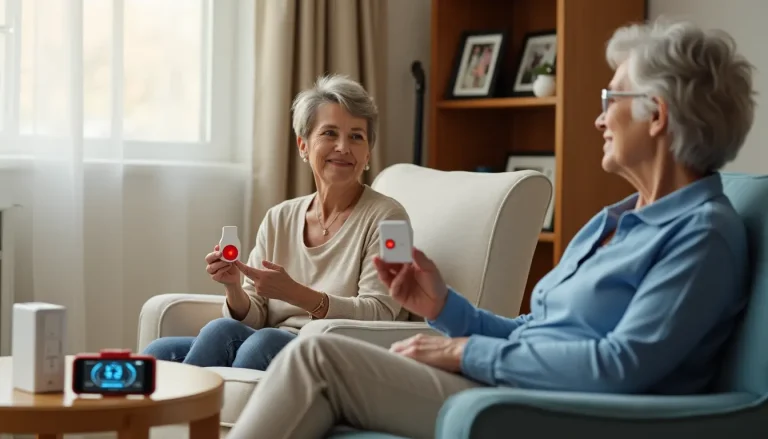
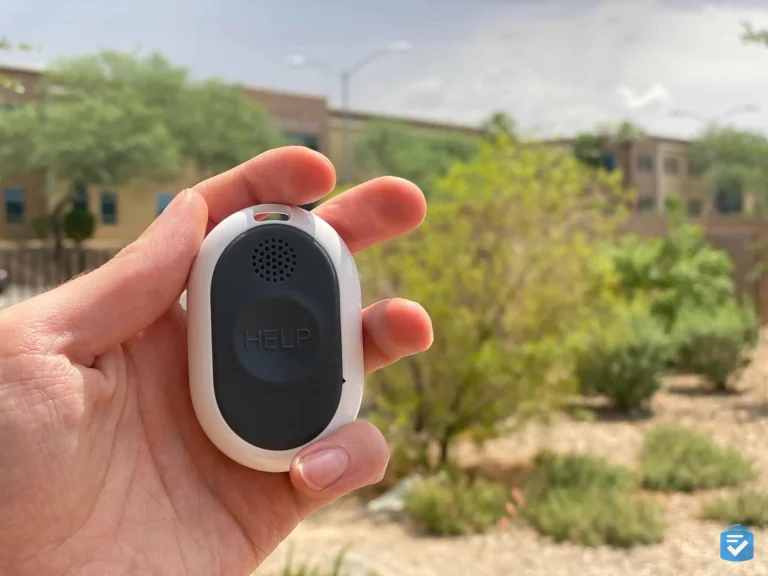
If a Belle W wearer cannot speak after an emergency, fall alerts and location data can provide the monitoring center with information that does not depend entirely on a verbal explanation from the user. Belle W offers optional fall detection, WiFi location services, proprietary homing technology, and 24/7 access to monitoring operators through its cellular connection.
Those features can support the response process, but they do not tell an operator exactly what medical event has occurred. Our public materials do not publish the complete escalation procedure we use specifically when a Belle W wearer cannot answer an operator. We therefore want to clearly separate what the device can transmit from what must still be determined during the response.
How Belle W Supports an Emergency Response Without Relying Only on Speech
Belle W combines monitored alerts, location information, and two-way communication to provide operators with useful information even when the wearer cannot clearly explain what has happened.
What Normally Happens When a Belle W Alert Reaches Monitoring?
Belle W is a wrist-worn mobile personal emergency response system, or mPERS. It includes a call button, built-in speaker and microphones, cellular connectivity, and access to operators around the clock. We state that the call button activates emergency communication with our monitoring center.
Under normal circumstances, that creates a two-way conversation.
The operator can speak with the wearer through Belle W’s built-in voice system, determine what help is needed, and respond according to the situation. Our operators can communicate with users and dispatch necessary assistance.
But emergencies do not always allow a clear conversation.
A person may be unable to respond after a fall, may be too far from the device’s microphone to speak clearly, or may otherwise be unable to provide the information an operator would normally receive verbally.
That is where the information generated by the alert itself becomes more important.
Can Belle W Send an Alert If the User Does Not Press the Button?
Yes, when optional fall detection is enabled and the device identifies a qualifying fall event.
We state, along with Belle W manufacturer Freeus, that Belle W offers fall detection with user cancellation. Freeus also states that its AVA platform processes every button press and fall event when it reaches the monitoring center.
This creates two different alert paths:
Manual alert: The wearer presses the emergency call button.
Fall alert: Enabled fall detection identifies an event and sends that event into the monitoring workflow.
The second path is particularly relevant when the wearer cannot press the button.
We specifically describe fall detection as capable of alerting our monitoring operation even when a manual button press does not occur.
Fall detection, however, should not be treated as a guarantee. It is an additional alert mechanism. It cannot be assumed to identify every possible fall, and the manufacturer does not claim that it diagnoses what caused the fall.
What Does the Monitoring Center Know From a Fall Alert?
A fall alert can tell the monitoring system that the device has identified an event that meets its fall-detection criteria.
That is useful information, but it is not the same as a medical diagnosis.
The alert does not inherently establish whether the wearer:
- fainted,
- tripped,
- experienced a medical emergency,
- was injured,
- or simply triggered a false alert.
Belle W includes user cancellation, which provides a way to cancel a fall event when assistance is not required.
If the user cannot speak, however, the operator may have less direct information about the reason for the alert. This is why the other available signals, particularly location information and the user’s configured emergency information, become more important.
Our public product pages do not provide enough detail to state exactly how every nonverbal or no-response fall alert is escalated. We encourage users and families to confirm that procedure with us during setup.
How Does Belle W Location Data Help?
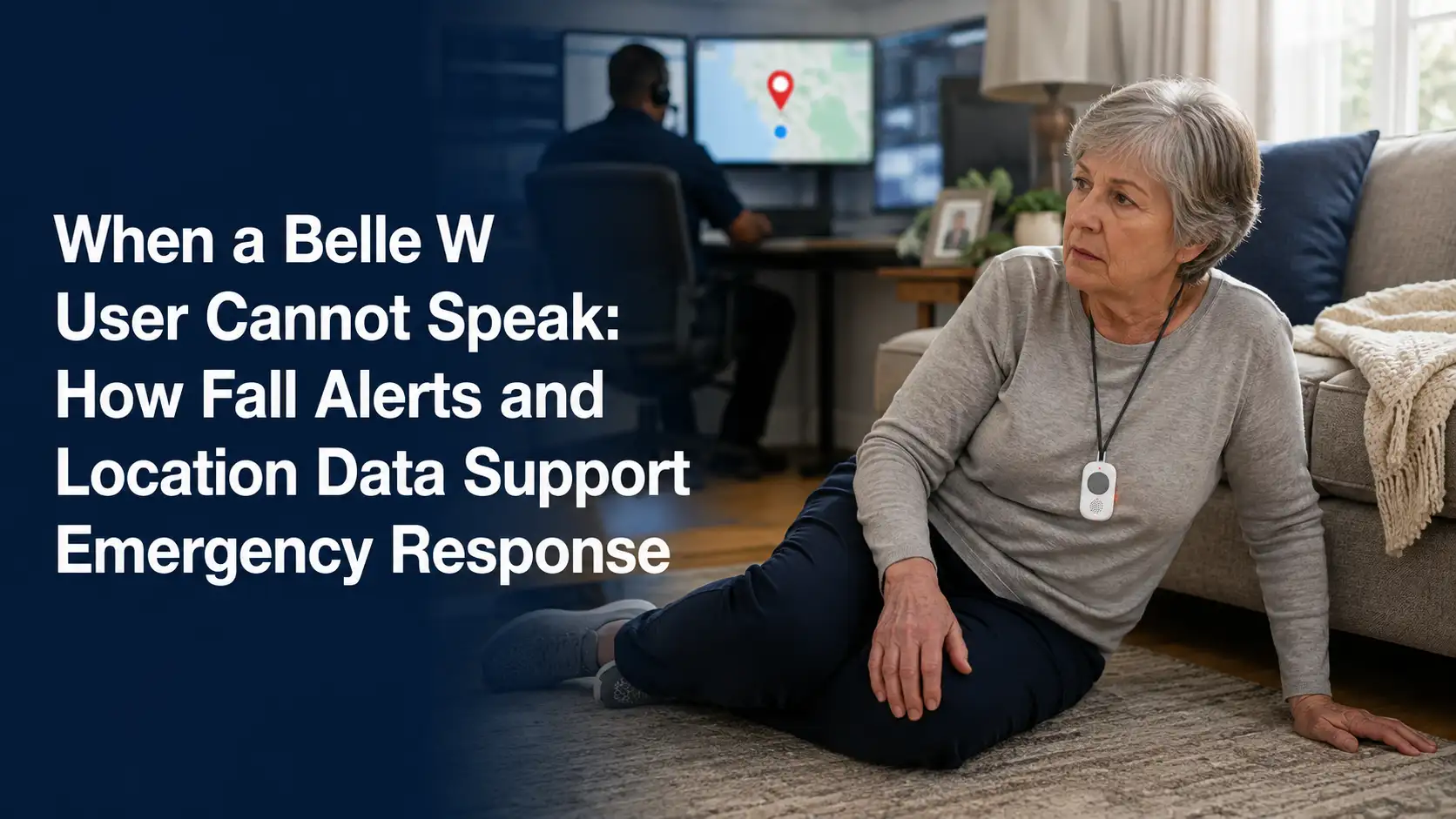
Belle W includes WiFi location services and proprietary homing technology.
We state that our monitoring center can determine the user’s location to support emergency response, while both we and Freeus describe Belle W’s homing technology as being able to determine whether the wearer is at home.
This matters when an operator cannot simply ask:
“Where are you?”
If the wearer can speak, the person may be able to provide a room, address, landmark, or other useful context.
If the wearer cannot communicate, device-derived location information may provide another source of information for the monitoring process.
For example, knowing that the device appears to be at the user’s home can be more useful than receiving an alert with no location context at all.
That is the practical role of fall alerts and location data working together:
Fall alert → identifies that a possible fall event occurred
Location service → helps establish where the Belle W device is located
Monitoring operator → uses available information to determine the appropriate response
The device itself does not diagnose the emergency.
Does Belle W Use GPS to Locate the Wearer?
This requires careful wording.
The dedicated current Belle W specifications from LifeRun and manufacturer Freeus identify WiFi location services and proprietary homing technology for Belle W.
On some of our other pages, we use broader wording such as “GPS Connectivity” when listing Belle W features.
Because our dedicated Belle W specification page does not list GPS as its location-service specification, we would not describe Belle W as a GPS medical alert watch based on our current device documentation.
Belle X is a separate LifeRun device whose manufacturer specifically lists GPS, WiFi, and cellular triangulation. Those Belle X specifications should not be transferred to Belle W.
For Belle W, the verified location terminology is:
- WiFi location services
- proprietary homing technology
- monitoring-center location support
Can the Operator Still Talk to a User Who Cannot Respond?
Belle W includes built-in two-way voice through its speaker and microphones. The operator can therefore attempt communication through the device after an alert reaches monitoring.
Two-way voice is important even when the wearer initially does not respond.
A user may become able to answer after a short delay, or the operator may be able to hear information from the environment.
However, our public materials do not document exactly how ambient audio is used when no verbal response occurs, so we do not claim that an operator can determine the nature of an emergency simply by listening through the device.
The safer distinction is:
Two-way voice provides an opportunity for communication. Fall and location signals provide information that does not depend entirely on that communication succeeding.
Why Do Emergency Contacts Matter in a No-Response Situation?
Our setup process includes confirming emergency contacts and creating a personal emergency protocol. Our published materials also state that our monitoring agents can contact family or send appropriate assistance depending on the situation.
This makes accurate setup information particularly important.
If a wearer cannot explain what has happened, the monitoring operation may need to rely more heavily on the information that was established before the emergency.
Families should therefore make sure that:
- emergency contact information is current,
- response preferences are understood,
- the device is assigned to the correct wearer,
- and LifeRun has the information required by its setup process.
The exact no-response escalation procedure should be confirmed directly with LifeRun rather than assumed.
Does Fall Detection Guarantee Help If Someone Becomes Unconscious?
No.
There are several independent requirements in the emergency chain.
Belle W must have sufficient battery power. The optional fall-detection feature must identify the event if no button is pressed. Compatible cellular service must be available for the alert to reach monitoring. The monitoring center must then receive and process that event.
That means fall detection should not be described as:
- guaranteed unconsciousness detection,
- guaranteed fall detection,
- guaranteed ambulance dispatch,
- or guaranteed emergency outcome.
It is a mechanism for creating an alert when a qualifying fall event is detected.
The device cannot determine every reason someone may be unable to speak, and not every emergency begins with a fall.
The manual call button therefore remains an important part of Belle W use whenever the wearer is capable of pressing it.
Cellular Connectivity Still Matters
Belle W is certified on AT&T and Verizon 4G LTE networks and works without a home landline or base station.
That allows the monitoring connection to travel with the wearer rather than being limited to one room or house.
But the device still requires compatible cellular coverage.
Location technology alone cannot send an emergency alert if the device cannot establish its required communications connection. Likewise, a fall event stored or detected by the device does not help the monitoring center until the information reaches the monitoring system.
Battery, cellular connectivity, fall detection, and monitoring therefore function as different parts of the same emergency-access chain.
The Alert Can Provide Information Even When the Wearer Cannot
The most important distinction is that Belle W’s emergency workflow does not depend entirely on the wearer being able to explain what happened.
With optional fall detection enabled, a qualifying fall can generate an alert even without a manual button press. Belle W’s location services can help the monitoring operation determine where the device is located. Its two-way voice capability gives operators an opportunity to communicate, while the monitoring service can then use the available information in the response process.
What Belle W cannot do is automatically determine why someone cannot speak or diagnose the underlying emergency.
Families considering Belle W for someone who may have difficulty communicating should ask LifeRun specifically how its no-response protocol works, which contacts are called, what information operators can see, and how fall alerts are handled when the wearer does not answer.
LifeRun helpline for customer questions and setup assistance 1-800-421-3366.
FAQs
Can Belle W send a fall alert if the wearer cannot press the button?
Yes, when optional fall detection is enabled and the device detects a qualifying fall event. We state that a fall alert can reach our monitoring operation without a manual button press.
Can the monitoring center locate a Belle W user who cannot speak?
Belle W includes WiFi location services and proprietary homing technology. We state that our monitoring personnel can determine the device’s location to support emergency response.
Does Belle W know why the wearer cannot respond?
No verified LifeRun documentation says Belle W diagnoses the reason a user cannot speak. The device can transmit an alert and provide location-related information, but the medical cause of an emergency must not be inferred from those signals alone.
Does Belle W automatically call an ambulance when a fall is detected?
We describe fall alerts as entering our monitoring workflow, where our operators can arrange appropriate assistance. Our public materials do not establish that every detected fall automatically results in EMS dispatch.
Does Belle W need cellular service for a fall alert?
Yes. Belle W uses cellular connectivity to reach the monitoring service and is certified on AT&T and Verizon 4G LTE networks. A fall alert cannot be assumed to reach monitoring where compatible cellular connectivity is unavailable.